5.12.2014

SaddleSore 2000 Ride Report: The First 24 Hours - Texas to Kentucky (1086 miles)

I was anxious as I checked the bike over one last time before donning my chaps, jacket, reflective vest, helmet, and gloves.  The time for planning and preparing was over.  It was time to ride and ride hard.  I kissed my wife, told her I’d be careful then eased back on the throttle, and pulled out of the garage to clear skies and bright stars.  At 12:50 a.m., my 2000-mile 48-hour Iron Butt adventure was officially underway.
Sunrise in Sulphur Springs, Texas
I stopped at a station about 3 miles from home to top off my tank and get a time/date stamped business receipt to document my start, then made my way to the Interstate.  Unlike most of the day, I-35 was almost empty.  It was as if I had the entire Interstate to myself. I enjoyed the quiet solitude and cool fresh air.  As I neared Austin, traffic began to pick-up and I was surprised at how many cars were on the road at 1:40 in the morning.  I was on high alert for drunk drivers as I made my way through downtown Austin.  My mom always said, “nothing good ever happens after midnight” so I imagined there were a few cars being driven by folks that may have partied a little too hard.  I kept my distance just in case.

Traffic thinned out after passing through Georgetown and I was once again alone.  There’s something peaceful yet slightly unsettling about riding the freeway at night.  I enjoyed the stillness, but was on edge thinking about animals lurking just outside the reach of my high beams.  I was torn between taking advantage of the open road and making the best time possible and riding more conservatively.  My fear of an undesired animal encounter won out and I kept my speed down accordingly. 

Somewhere between Austin and Temple, I realized I was getting cold.  Prolonged exposure to the cool air was having a chilling effect and was beginning to make me uncomfortable.  I kicked myself for not wearing an additional layer but was thankful I had packed my heated jacket liner.  I wouldn’t be cold for long.  I pulled into the Smart Stop in Waco at 3:37 a.m., right on schedule.  I got gas, completed my log entry, and put my heated liner on under my leather jacket.  I was back on the road in less than 15 minutes.

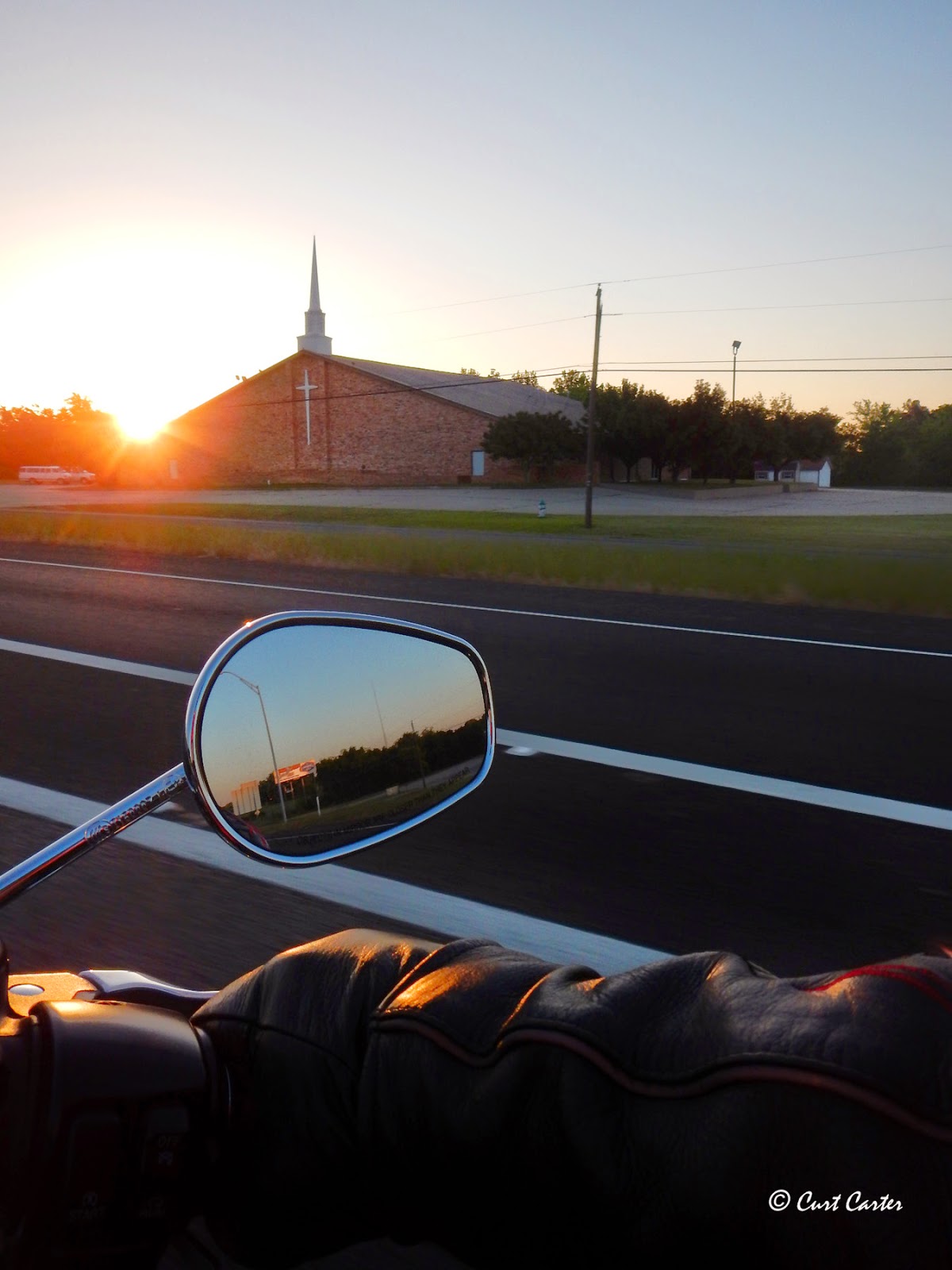
My heated liner kept me toasty warm as I made my way through Dallas and beyond.  I felt good.  As the sky began to lighten, I was overcome by a sense of reverence.  I thanked God for the opportunity to experience the ride and for the promise of a new day.  No matter how dark the night, we can always take comfort in knowing the sun will rise to light our way.  Within minutes of my 6:26 a.m. fuel stop in Sulphur Springs the sun fully broke the horizon…it was glorious.  With a renewed spirit, I twisted the throttle hard for my final push out of Texas.

The sign at the Arkansas state line was a welcome sight.  There’s something mentally refreshing about
entering a new state. You feel closer to your destination and it gives you a boost of energy.  Unfortunately, my exuberance didn’t last long.  Shortly after stopping in Prescott for gas, the state rolled out the real “Welcome to Arkansas” sign--road construction ahead.  Mile-after-mile of one-lane only, time-killing construction.   I thought I was in purgatory as I crept along in a line of traffic moving 55-60 miles per hour.  I was on the clock and needed to average at least 63 mph to complete the ride on time. After what seemed like an eternity, the road opened up and I pressed hard to get through Little Rock and on to Wheatley as quickly as possible.

Arkansas Road Construction
I pulled into the MAPCO in Wheatly at 11:20 a.m., 35 minutes ahead of my planned arrival time.  I was pleased with my time but starting to feel the effects of the last 650 miles.  The backsides of my legs where they contact the saddle were starting to get a little tender. It was time to take a break.  I gassed-up, completed my log, pulled a Gatorade out of the cooler in my large Viking Bag, and went inside for something to eat.  They had a nice variety of everything, as long as it was chicken.  I ordered two chicken strips and two biscuits.  I must have been hungry because I thought they were the best chicken strips I ever tasted.  After an extended 45+ minute break, I felt rejuvenated.  I geared-up and pressed toward my next stop, Jackson Tennessee.

Sadly, Arkansas wasn’t finished with me.  Shortly after leaving Wheatley, the entire eastbound side of I-40 was shut down with one lane of traffic being diverted to the westbound side.  For almost two miles, traffic inched along before folks fully made the transition and began moving at 50-55 miles per hour.  The construction zone ended about 15 miles east of Memphis.  I twisted the throttle to make-up some time.  I was going 70-75 when I hit a poorly filled pothole and my cell phone popped out of its RAM mount on my left handlebar.  I watched in terror as it fell behind me.

My first thought was “my phone is gone and I need to keep going”, but my second thought was “what if I find it and it still works”.  Being the eternal optimist, I pulled over as quickly as I could and began my walk of shame.  I had no idea exactly where it fell off and wasn’t sure that it might not have been run over by an 18-wheeler.  I kept walking.  After what seemed like a quarter mile, I was ready to give up but at that moment saw it lying screen down on the shoulder. I picked it up. The screen was shattered and its body was mangled.  I had little hope that it would still work but gently pressed the home button.  To my amazement, the screen lit up and everything appeared to work.  Hallelujah!  I made my way back to the bike, put the phone back in the RAM mount, double checked to see if it was secure, and merged back onto the Interstate.

Finally, I'm leaving Arkansas!
The Mississippi River and Memphis were a welcomed sight.  Arkansas hadn’t been very nice to me and I was happy to see it in my rear view mirror.  Traffic in Memphis was light and I quickly made my way through the city.  I was a little distraught when I heard a woman’s voice in my helmet say, “low battery, goodbye”. With my nether regions becoming more tender with each passing hour, I couldn’t imagine five more hours on the road without some form of entertainment to distract me. Not to mention what my wife would start to think when her calls went to voicemail.  Although I didn’t want to lose any saddle time, I decided I’d look for a micro-USB/USB cable in Jackson so I could run power to my Bluetooth headset.

After about an hour and a half of silence, which really wasn’t bad, I lucked upon a Wal-Mart just off the Interstate in Jackson.  Getting in and out of the parking lot took forever but I found what I needed and reestablished my communications and entertainment capability.  I rode another five miles up the Interstate to my designated fuel stop and filled-up. Even after searching for my phone and my Wal-Mart detour, I was about 5 minutes ahead of my plan.  I was thankful I had been able to run 70-75 miles an hour for most of the trip. Barring any additional delays, I calculated I’d get to my dad’s by nightfall.

Although there was some road construction and moderate traffic, my ride from Jackson through Nashville was uneventful.  I was able to maintain a good speed and the weather was perfect.  As I rode through Nashville, I remembered at one time there was an Oscar Mayer plant just off I-65.  I watched for it but never saw it.  I guess it has long since closed but thinking about it put a smile on my face as I sang the Oscar Mayer Bologna song from my childhood.  I’m glad I have a full-face helmet, otherwise people would’ve thought I was crazy.

Shadow Rider
I crossed the Kentucky state line at approximately 5:35 p.m. with a renewed sense of energy.  It felt good knowing that I only had a couple of hours left on the bike.  It had become almost impossible to find a comfortable spot to sit in the saddle or place my feet on the pegs.  I was happy to take a short fuel break in Franklin.  I stretched and ate a little jerky after filling my tank.  After drinking a quick bottle of Gatorade, I mounted the bike and rode knowing my next stop would be it for the night.

Making my way up I-65 I couldn’t help but be impressed by the green pastures and smell of fresh air. 
Kentucky is a scenic place and the ride to Louisville was proving to be quite enjoyable.  As the sun moved lower on the horizon, it was peaceful watching the landscape change colors and the shadows come out to play.  I snapped several photos of the shadow rider riding next to me.  Shortly after crossing into the Eastern Time zone, I called my dad to discuss dinner plans.  He told me dinner was waiting for me.  I pulled into my dad’s driveway just as the last bit of daylight was consumed by darkness. I pulled into the garage and slowly got off the bike.  It had been a long day.  I covered 1086 miles 18 hours and 55 minutes. In just about 9 hours I’d be doing it all over again.  It was time to eat and go to bed...


It fell off the bike at 70 mph and still works!

Riding with the shadows in Kentucky

Who is this guy and why is he following me?

Changing landscape as sun goes down

_____________________________
Coming Soon…Saddlesore 2000 Ride Report: The Long Ride Home – Kentucky to Texas (1086 miles).

5.01.2014

The Key to Iron Butt Certification…Document, Document, Document

I’ve ridden the SaddleSore 2000 in my head a hundred times and I’m comfortable with my ride plan. I’ll start at 1:00 a.m. on Saturday, 3 May and with a little luck will finish by midnight on Sunday, 4 May. If all goes as planned, I’ll complete the 2000-mile ride within the required 48 hours. All that will be left to do is turn in my documentation package and pay the certification fee. Sounds easy, right? Wrong.

 To be fair, the process isn’t too difficult but it is rigorous and requires attention to detail. The Iron Butt Association doesn’t just hand out certificates and pins to anyone who claims to have completed an Iron Butt ride. They make you prove it, and they do that by requiring you to document all aspects of your ride. Once you’ve submitted your package, they do a thorough review to verify you rode the ride you claimed.

 For SaddleSore and BunBurner rides, the documentation requirements are the same. You’ll need to provide:
  • Information on yourself and your motorcycle 
  • Certification fee (check or money order) for ride being certified Signed witness statement for both the start and end of ride 
  • Log of all stops Copy of all gas receipts (time and date stamped) annotated with odometer reading at the time of stop 
  • Map showing an overview of the route followed 
  • Notes on difficulties encountered (i.e. unable to obtain a receipt, etc.) or any other information to assist the verification process 
 For me, these requirements were a little overwhelming at first. I was concerned I might miss or forget something along the ride and not have what was required to complete the certification process. To keep this from happening, I created a certification documentation package template in Microsoft Word. I used the template to create the certification package for my Texas Tour of Honor Extreme BunBurner ride and it helped me keep things straight. I carried the paperwork in a folder and used it at every stop to capture the required information. I kept all my receipts in a zip-lock bag. Once I completed the ride, I scanned my receipts and added them to the document package. I then printed-out the entire document and mailed it to the IBA for certification. About eight weeks later, I received my IBA BunBurner certificate letting me know the ride was certified. Success!

 Here’s a copy of the certification documentation package I used for my BunBurner ride, I’ll create a similar one for the SaddleSore 2000. If you’d like a fill-in-the-blank MS Word version you can edit to document your Iron Butt ride, leave a comment and let me know how to reach you…I’d be happy to send it to you.

You can increase your chance of Iron Butt success by planning your ride, riding your plan, and remembering to document, document, document. While you’ll always have the personal satisfaction of completing a challenging ride, if you don’t document it properly, the IBA won’t certify it as an “official” Iron Butt ride. Hopefully the information shared here has helped demystify the documentation process and will help you reach your Iron Butt goals.

If you’d like to do a virtual ride along on my SaddleSore 2000, visit my Ride Along page and follow my progress on the SpotWalla map. It should start updating around 1:00 a.m. on Saturday, 3 May. It’s almost time to ride…

 _____________________________
To learn more about the various Iron Butt rides and rules check-out the IBA website.

4.24.2014

Scratching My Long Distance Itch

It’s been six months since my last Iron Butt Association (IBA) long distance ride and I’m getting a little anxious for another challenge.  After completing the BunBurner 1500 in under 36 hours in October 2013, I’ve set my sights on the Saddlesore 2000 (2000-miles in under 48 hours).  I’ve mapped out an all Interstate route between San Antonio and my Dad’s house in Louisville, KY for a round-trip total of 2172 miles.  I should be able to make the 1086-mile one-way trip, get 7 to 8 hours of sleep, and return to San Antonio all in about 47 hours.

I originally wanted to do this in March but the weather in both Texas and Kentucky was cooler and wetter than normal, so I put it off.  Now I’m looking at early May and hoping the weather will cooperate.  Sure, I could’ve ridden in the cold and rain but it’s not as fun.  Some might question my judgment on calling this kind of ride fun, but there’s something very exhilarating and challenging about it.  Try sitting in a saddle for hours on end.  It isn’t as easy as it sounds, but it’s not impossible either. You just have to want it.  Hell, It’s an adventure!

San Antonio to Louisville - 1086 miles
I considered a couple of factors to increase my chances for a successful ride.  First, the number of miles I can reasonably travel on a tank of gas.  With a 4.5-gallon tank, I can go about 170 miles at highway speeds without too much fear of running out of gas.   Based on this, I’ve planned gas stops about every 165 miles.  The downside to this relatively short gas interval is I’ll have to make quite a few stops and stops eat-up time, which is a precious commodity on any Iron Butt ride.  I hope to keep most stops to no more than 12 minutes to minimize the time I’m off the bike. 

Another factor I looked at is start time.   I’d like to avoid as much traffic as possible while riding through Austin, Dallas, Little Rock, Memphis, and Nashville and I’d like to complete the ride in time to get a few hours sleep before going to work. I considered taking a Friday off and getting an early start but after looking at several scenarios, it became evident that no matter when I left I was likely to hit traffic in at least one of the cities I’d be riding through.  In order to avoid traffic and get home in time to get some sleep before work, I’ve decided to start the ride around 1:00 a.m. on a Saturday morning.  If I maintain a 63 mph moving average, I should avoid traffic jams and be finished by midnight Sunday.  I’m hoping since the entire route is on the super slab I won’t have issues maintaining that moving average.

My SaddleSore 2000 Ride Plan

My wife thinks I’m crazy as do some of my friends but to me it seems perfectly normal.   It may be a little extreme but that’s what makes it interesting.  I certainly won’t be the first person to try a ride like this and I won’t be the last.  There’ve been plenty of riders who’ve completed a SaddleSore 2000…and IBA rides even more difficult and extreme.  Life is meant to be lived and sometimes we have to step out of our comfort zones to know what it truly means to be alive.  We should never let fear and complacency define us.  We should strive to Live Free, Ride Hard, and Be Happy every day!

Wish me luck!

***************
Want to know more about the Iron Butt Association (IBA)?
Running the super slab? Here’s a nice tool for planning your gas stops.
Get some tips from a seasoned long distance rider…Tim Masterson

4.11.2014

Protect Your Egg…Have You Considered the Risks?


Protected Egg
Helmets and helmet laws make for an interesting and sometimes polarizing discussion within the motorcycling community.  Personally, I always wear a helmet but I don’t believe in legislating compliance. Although I’ve worked in and around government all my life, I’m not a big-government kind of guy.  I believe in individual responsibility and freedom of choice.  As riders, we know motorcycling is inherently more risky than driving a car and we accept that fact.

In order to stay alive on a motorcycle, we need to understand the risks we face and the tools we have available to manage/mitigate those risks.  To gain a better understanding of one of the tools in our rider toolbox, I asked motorcyclists on Reddit and Google+ about their helmet wearing habits and what they thought about mandatory helmet laws.  I received over 200 comments from riders across the world. I’ve summarized some of the more common responses and conditions riders listed for wearing or not wearing a helmet in the Table below.  Not surprisingly, most riders who responded said they were NOT in favor of mandatory helmet laws…bikers are definitely an independent lot.

Table:  Common Reasons/Conditions

Wear A Helmet
Don’t Wear A Helmet
Protect My Head/Face
Better Visibility/Hearing
Don’t Like Rocks/Bugs in Face
Feels Good - Wind in Hair/Face
Wind At Speed Hurts Face
Hurts Head/Neck
Saved Life in Previous Accident
Biker Culture
Only In Town
Never Ride on Highway/Never Ride Fast
When Travelling at High Speeds
When Travelling at Low Speeds
Consideration for Family
It Messes Up My Hair
It’s the Law
Stick it to “The Man”

I was surprised by some of the reasons and conditions given because they potentially indicate a misunderstanding about what helmets are designed to do.  While DOT and Snell rated helmets are designed to protect us from head and brain injuries, that protection is optimized for a limited set of conditions.  Contrary to what some may think, helmets are not designed for direct high-speed impacts. By design, helmets provide the greatest protection for impacts under 30 mph.

DOT helmet standards focus on three areas of performance: impact attenuation/energy absorption, penetration resistance, and retention system effectiveness.   From an impact point of view, helmets are tested via a drop test and allow for a peak acceleration of 400 G (G is gravity constant).  This is effectively like travelling 13.5 mph and hitting a stationary/immovable object (with your head) and coming to a complete stop in 1.5 milliseconds.  That’s a lot of force!  It’s easy to see why helmets aren’t very effective in direct high-speed impacts…the brain can’t survive the higher G forces.   Fortunately, most motorcycle accidents occur at speeds well under 30 mph and most don’t involve decelerating to a complete stop in under 0.0015 seconds…conditions where helmets protect the best.

Although it may be somewhat dated, the Hurt Study: Motorcycle Accident Cause Factors and Identification of Countermeasures provides some great insights into motorcycle accidents and prevention.  Every rider should read the study summary, but here’s what I found most interesting:

  • Three-fourths of motorcycle accidents involve collision with another vehicle (usually a car).
  • One-fourth of motorcycle accidents are single vehicle accidents involving the motorcycle colliding with the roadway or some fixed object.
  • Rider error is responsible for two-thirds of single vehicle accidents, with the typical error being a slide out and fall due to over braking or running wide on a curve due to excess speed or under-cornering.
  • Most motorcycle accidents involve short trips (i.e. shopping, errands, friends, entertainment or recreation) and are most likely to happen shortly after starting the trip.
  • The median pre-crash speed was 29.8 mph, the median crash speed was 21.5 mph, and the one-in-a-thousand crash speed is approximately 86 mph.
  • Intersections are the most likely place for a motorcycle accident, with the other vehicle violating the motorcycle right-of-way, and often violating traffic signals.
  • The failure of motorists to detect and recognize motorcycles in traffic is the main cause of motorcycle accidents (i.e. “I didn’t see a motorcycle”).
  • More than three-fourths of all accident hazards are within 45 degrees of either side of straight ahead… peripheral vision is generally not a factor.
  • Voluntary helmet use by riders involved in an accident was lowest for untrained, uneducated, young riders on hot days and short trips.
  • The majority of riders involved in accidents have essentially no formal training (i.e. MSF, Riders Edge, etc.). Formal rider training reduces accident involvement and is related to reduced injuries in an accident does occur.

Unprotected Egg
From a risk management perspective, wearing a helmet won’t reduce your chances of being involved in an accident but it will reduce the probability of sustaining a head/brain injury.  As riders, we should make deliberate decisions about the gear we wear.  While “sticking it to the man” or “not wanting to mess up your hair” may be valid personal reasons for not wearing a helmet, neither indicates you’ve consciously (no pun intended) thought about the risks you’ll encounter on your ride.

So, will you protect your egg?  Whatever you decide is up you…you just need to understand the risks and be willing to accept them.  Remember, Live Free, Ride Hard, Be Happy…and Ride Safe!

______________________________________

References: